Best Gold IRA Companies of 2026
An unbiased comparison framework for 401(k) and IRA rollovers — matched by investor category, measured on minimum investment, fee transparency, storage terms, and rollover support.
Quick answer: what are the best gold IRA companies?
The best gold IRA companies in 2026 are the ones whose minimum investment, fee structure, and support model match your allocation size. For rollovers of $50,000 or more where education matters most, Augusta Precious Metals is the most commonly cited fit thanks to its one-on-one analyst web conference and flat, written fee schedule. For allocations closer to $10,000–$25,000, Birch Gold Group and Goldco offer lower entry points and broader metal inventory. All IRA metals must be held by an approved custodian at an IRS-approved depository.
401(k) / IRA Physical Precious Metals Allocation Calculator
Model how much physical gold and silver a given retirement allocation could represent, and see how annual storage fee structures compare at that size. Figures are estimates for planning only.
Spot baselines used: gold $3,300/ozt, silver $40/ozt. Estimates only — live dealer pricing includes premiums and spreads.
Total capital allocated to physical metals
$15,000
15% of $100,000 — $7,500 gold / $7,500 silver
Estimated physical gold
2.27 troy oz
71 grams
Estimated physical silver
187.5 troy oz
5.83 kg
IRS-approved storage fee tier estimate
Flat annual tier
$330 / yr
Custodian + depository, unchanged as the balance grows.
Scaled tier (~0.75%)
$113 / yr
About $218 less per year than flat at this size.
Rollover guidance
Recommended for lower minimum entry custodians ($10k–$25k) like Birch Gold Group or Goldco.
How 401(k) to Gold IRA Rollovers Protect Retirement Purchasing Power
A 401(k) to gold IRA rollover moves a portion of tax-advantaged retirement savings out of paper-denominated assets and into physical bullion held inside a self-directed IRA. The reason retirement investors consider it is purchasing power: currency debasement, sustained deficit spending, and long inflation cycles erode what a fixed dollar balance can buy decades from now. Physical metals behave differently from equities and bonds, which is why an allocation is usually framed as diversification rather than as a growth engine. Nothing here guarantees a return, and gold prices can and do fall.
Mechanically, the process has four steps: open a self-directed IRA with an approved custodian, initiate a direct rollover or trustee-to-trustee transfer from the existing 401(k), 403(b), TSP, or IRA, select IRS-eligible metals through your dealer, and have those metals shipped directly to an approved depository under the custodian's title. Handled as a direct transfer, funds never pass through your hands. Typical timelines run seven to twenty-one business days, and the biggest source of delay is almost always the releasing plan administrator, not the gold IRA company.
Understanding Physical Gold and Silver Weight Conversions (Ounces to Grams & Kilos)
Precious metals are priced in troy ounces, not the standard avoirdupois ounce used for groceries. One troy ounce equals 31.1035 grams — roughly 10% heavier than the ounce most people picture. A one-kilogram gold bar therefore holds about 32.15 troy ounces, and a standard 100-ounce silver bar weighs roughly 3.11 kilograms. Those conversions matter when you compare quotes: dealers may quote per gram, per troy ounce, or per bar, and premiums differ sharply between fractional coins, one-ounce coins, and larger bars. The calculator above converts automatically so you can sanity-check what a given allocation actually buys in physical weight.
Evaluating Self-Directed IRA Storage Fees, Spreads, and Buyback Terms
Three costs decide the real price of a gold IRA. First, annual administration and storage: either a flat schedule that stays constant as your balance grows, or a scaled percentage that compounds against you at higher balances. Second, the spread — the difference between what the dealer charges you and what the metal is worth at spot. Bullion spreads are typically modest; proof and "exclusive" coin spreads can be several times higher, and that is where most complaints in this industry originate. Third, buyback terms: ask which price basis a company uses when repurchasing, how quickly they settle, and whether the offer is contractual or discretionary. A company that answers all three in writing before you fund is telling you something useful about how it will behave afterward.
2026 Comparison of Top IRS-Approved Gold Custodians and Depositories
There is no single "best" provider — there is a best match for your allocation size and how much guidance you want. Below, providers are grouped by investor category rather than ranked.
Augusta Precious Metals
Augusta's model is built around a one-on-one web conference with a Harvard-trained economic analyst before any paperwork begins, a stated zero high-pressure sales commitment, and transparent flat pricing disclosed in writing. The $50,000 minimum is higher than most of the field — that is a genuine trade-off. In practice it exists because the account is staffed with dedicated concierge support for the life of the account rather than a single onboarding call.
- ◆Flat, written fee schedule rather than scaled percentages
- ◆Private educational web conference before purchase
- ◆Lifetime account team, not a 30-day handoff
- ◆Higher $50,000 entry point — better suited to rollovers than starter accounts
Birch Gold Group & Goldco
If you are allocating under $50,000, these two are the names most commonly used for a lower barrier to entry. Both open accounts in the $10,000–$25,000 range and carry wide physical inventories across gold, silver, platinum, and palladium. Support is generally specialist-assigned but less concierge-oriented, and fee schedules are typically disclosed on request rather than published, so ask for the itemized numbers in writing.
- ◆Entry points commonly from $10,000–$25,000
- ◆Broad physical inventory across four metals
- ◆Guided rollover assistance and starter education kits
- ◆Fees usually disclosed on request — request them before funding
| Company | Minimum Investment | Fee Transparency Structure | Best Suited For | Action |
|---|---|---|---|---|
| Augusta Precious Metals | $50,000 | Flat annual structure, disclosed in writing | $50k+ rollovers wanting education-first onboarding | Compare details ↗ |
| Birch Gold Group | ~$10,000 | Disclosed on request; often flat storage tiers | Lower minimums and diversified metal selection | Compare details ↗ |
| Goldco | ~$25,000 | Disclosed on request; promotional credits common | First-time buyers wanting a guided rollover | Compare details ↗ |
Minimums and fee structures change without notice. Verify current terms directly with each provider and with a tax or financial professional before acting.
What Retirement Investors Say About Gold IRA Providers
★★★★★“The education came first. I sat through the web conference and never once felt pushed toward a product I didn't understand.”
Illustrative customer sentiment collected from public review themes. Individual experiences vary.
Separating Gold IRA Dealers, Self-Directed Custodians, and Approved Depositories
Every compliant gold IRA involves three separate entities, and understanding the split is the fastest way to spot an operator worth avoiding. The dealer educates you and sources the metals. The custodian is a regulated trust company that legally holds the IRA and handles tax reporting. The depository is the insured, IRS-approved vault where the metal physically sits. If any company implies you can hold IRA metals at home or bypass a custodian, treat that as disqualifying.
Gold IRA Dealer
Educates, sources IRS-eligible bullion, coordinates paperwork. Paid through the markup on metals.
Self-Directed Custodian
Regulated trust company holding legal title to the IRA and filing required reports. Charges annual admin fees.
IRS-Approved Depository
Insured vault — Brink's, Delaware Depository, IDS of Texas — with segregated or commingled storage options.
Red Flags That Should End the Conversation
- ⚠Marketing for "home storage" or "checkbook" gold IRAs
- ⚠Pressure toward proof or exclusive coins at large premiums over spot
- ⚠Refusal to provide an itemized fee schedule in writing before funding
- ⚠Vague answers about custodian, depository, or insurance coverage
- ⚠Guarantees of returns or claims that gold "cannot lose value"
- ⚠One-day-only pricing or manufactured scarcity
- ⚠No stated buyback price basis or settlement timeline
- ⚠The salesperson becomes unreachable once the wire clears
Who a Physical Precious Metals IRA May Suit
This structure tends to fit investors who already hold meaningful retirement savings elsewhere, who want a modest physical allocation for diversification, and who accept trading some liquidity and growth potential for a different kind of exposure. It suits people comfortable with a multi-year horizon and with holding an asset that produces no yield. It is generally a poorer fit for those early in their savings journey, anyone who may need the funds within a few years, or anyone who would end up over-concentrated in a single asset class. None of this is personal financial advice — run any rollover decision past a fiduciary advisor and a tax professional, particularly if required minimum distributions are in play.
Questions to Ask Before Opening a Gold IRA
Bring this list to your first call with any provider. The quality of the answers tells you nearly everything.
- 01What are your total first-year and ongoing annual fees, in writing?
- 02Which custodians and depositories do you work with, and can I choose?
- 03What is the spread or markup on the specific coins or bars you recommend?
- 04How do buybacks work if I want to liquidate, and what price basis do you use?
- 05How long does a typical 401(k) or IRA rollover take from start to funded?
- 06Which precious metals products are IRA-eligible under current IRS rules?
- 07Will I have a dedicated point of contact after the account is funded?
- 08Is my storage segregated or commingled, and what does the insurance cover?
- 09What is your policy on proof or 'exclusive' coins versus standard bullion?
- 10What happens to the account if I move, pass away, or take an in-kind distribution?
Gold IRA Rollover FAQ: Fees, Storage, Minimums, and Liquidation
Ten of the most common questions searchers ask before choosing a provider.
What is the minimum amount required for a Gold IRA rollover?+
There is no IRS-mandated minimum for a gold IRA — the minimum comes from the company you work with. Entry-level providers such as Birch Gold Group and Goldco commonly start around $10,000 to $25,000, while Augusta Precious Metals publicly states a $50,000 minimum because its model is built around concierge-level education and dedicated lifetime account support. Confirm current figures directly with each provider.
How do I transfer a 401(k) to a physical gold IRA without tax penalties?+
The generally accepted route is a direct rollover or trustee-to-trustee transfer: you open a self-directed IRA with an approved custodian, the funds move institution-to-institution, and you never take personal receipt of the money. Indirect rollovers (where a check is issued to you) carry a 60-day deadline and possible withholding. Rules vary by plan and by situation, so confirm the mechanics with your plan administrator and a qualified tax professional before initiating anything.
What is the difference between physical bullion and proof coins?+
Bullion is valued primarily on metal content and typically trades close to spot with a modest premium. Proof coins are collector-grade strikes with higher premiums that reflect rarity, finish, and mintage rather than metal weight alone. Bullion tends to be easier to price and liquidate; proof coins can carry much wider spreads, which is why aggressive proof-coin selling is a common complaint in this industry.
How are my metals stored in an IRS-approved depository like Brink's or Delaware Depository?+
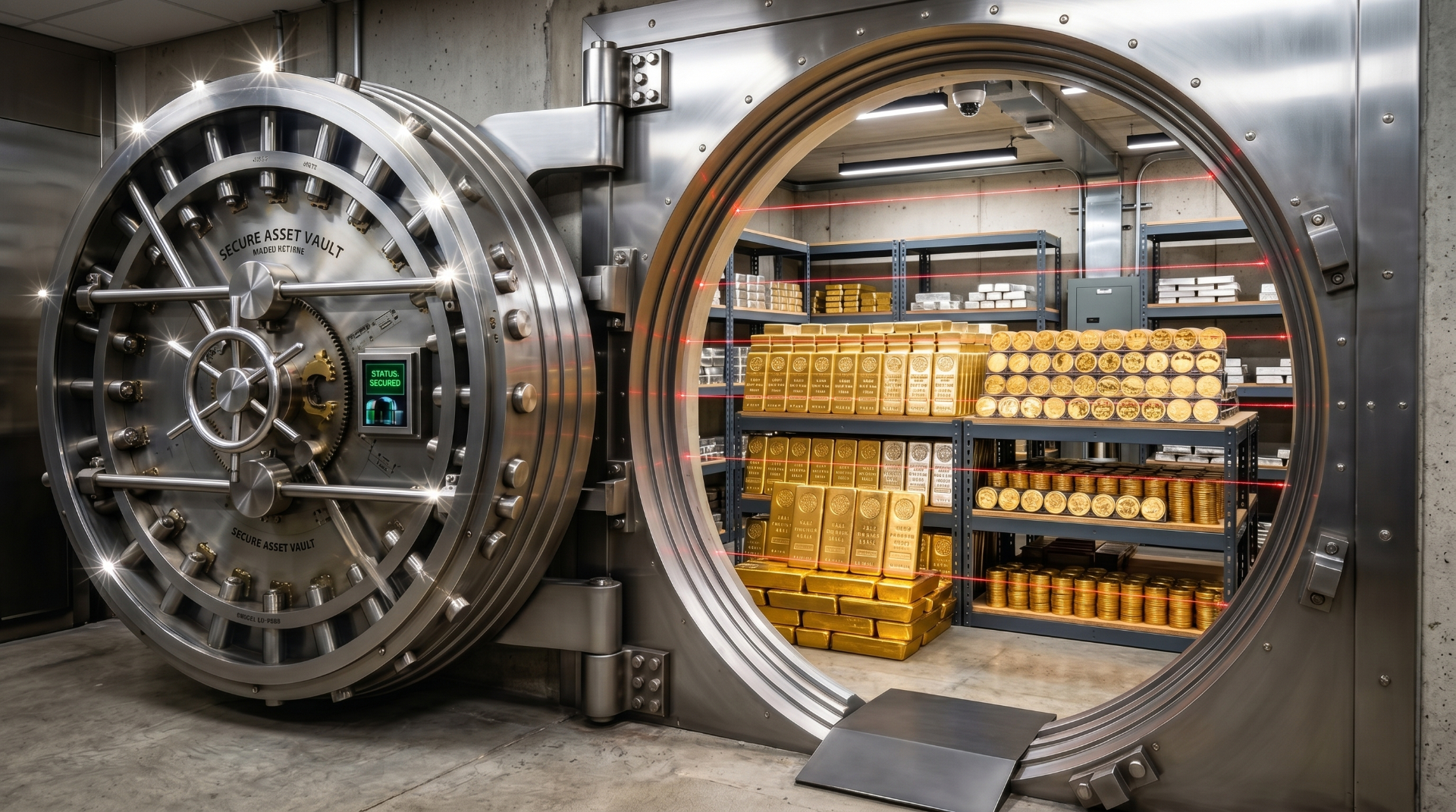
IRA-owned metals must be held by the custodian at an IRS-approved depository — not at home. Facilities such as Brink's Global Services, Delaware Depository, and IDS of Texas provide vaulted, insured storage with regular audits. You can usually choose between segregated storage (your exact bars and coins kept separately) and commingled storage (pooled with like products). Ask for the insurance policy details and audit schedule in writing.
Why does Augusta Precious Metals require a $50,000 minimum?+
Augusta positions itself around one-on-one education rather than volume sales — including a private web conference with a Harvard-trained economic analyst and a lifetime account support team. That level of dedicated service is expensive to deliver, so the account size threshold is set higher. It is not inherently better or worse than a lower minimum; it simply targets rollover-sized retirement accounts rather than small starter positions.
How many grams or kilos of physical metal can I hold in my IRA?+
There is no weight cap — the limits are contribution and rollover rules, not ounces. What matters is eligibility: gold must generally meet 0.995 fineness (0.999 for silver) with specific approved coins such as American Eagles. For context, one troy ounce equals about 31.10 grams, so a 100-ounce silver position is roughly 3.11 kilograms.
What are the annual custodian and depository storage fees?+
Typical structures include a one-time setup fee (often $50–$250), an annual custodian/administration fee (often $75–$150), and annual storage (either a flat $100–$250 or a scaled fee of roughly 0.5%–1% of asset value). Metal markups and spreads are separate. Always request a written, itemized schedule before funding.
Can I take physical possession of my gold and silver upon retirement distribution?+
Yes — many custodians support an in-kind distribution, where the actual coins or bars are shipped to you instead of being sold. The distribution is still a taxable event under normal IRA rules, and early distributions may trigger penalties. Verify the process, shipping insurance, and tax treatment with your custodian and tax advisor.
How does the buyback process work when I want to liquidate?+
Most dealers offer a buyback program: you request a quote, they price your holdings against current spot minus their spread, and the custodian releases the metals from the depository once terms are agreed. Buybacks are typically not legally guaranteed, so ask each company what price basis they use, how quickly they settle, and whether there is any minimum.
What makes a flat annual fee structure better than a scaled percentage fee?+
A flat fee stays the same regardless of account value, so costs do not grow as your holdings grow. A scaled percentage fee rises with the balance — on a $250,000 position, a 0.75% scaled fee is meaningfully more per year than a flat $200. Scaled pricing can be cheaper on small accounts, which is why the right answer depends on your allocation size rather than on marketing claims.
Compare in Writing Before You Commit
Request the free educational kit, then hold it against every other provider on this page — minimums, fee schedule, storage terms, and buyback basis. No commitment required.